Wetland Coffee Break
The Wetland Coffee Break series helps keep our community of wetland lovers connected and learning about wetlands throughout the year, from anywhere! Bring your coffee and learn about wetlands, the plants and animals that call them home, and the many natural benefits they provide to our communities. Sessions are held on Zoom and feature time for audience Q&A.
See below for a list of upcoming presentations and to register. Once you register, you’ll receive an automatic email including the URL link and password you’ll need to access the meeting. We record and post each presentation so you can watch any that you missed live. You’ll find links to these recordings below, and you can also find them on our Facebook page.
We are grateful to all of the presenters for sharing their knowledge and expertise and to everyone interested in learning more about wetlands! If you are interested in giving a Wetland Coffee Break presentation, or if you have a wetland topic you’d like to see covered, please contact Katie.Beilfuss@wisconsinwetlands.org.
We are now able to provide attendance verification to Wetland Coffee Break audience members who attend the live sessions and request this service. We created this mechanism in response to requests from members of the Wetland Coffee Break audience who would like to apply their Wetland Coffee Break learning to their continuing education or certification requirements. Learn more about how to receive attendance verification here.
Register for a Wetland Coffee Break
Nest site selection for Whooping Cranes in Wisconsin wetlands
Nicki Gordon, International Crane Foundation
Friday, April 10, 2026
10:30 am CT
Description
The reintroduction of the Whooping Cranes in Wisconsin as part of the Eastern Migratory Population began in 2001 with the release of juveniles raised in human care at Necedah National Wildlife Refuge. As Whooping Crane release sites expanded to additional areas across the state, questions emerged about how wetland habitat characteristics influence nest site selection and hatching success. Join Nicki Gordon of the International Crane Foundation to learn about efforts to evaluate and compare habitat characteristics across breeding areas throughout Wisconsin, work that will provide guidance for wetland management and selection of future crane release sites.
Nicki Gordon grew up in northwest Ohio and earned her bachelor’s degree in biology from Bowling Green State University. She completed her master’s degree in wildlife ecology at UW-Madison, focusing on predator occupancy on the breeding grounds of the Eastern Migratory Population of Whooping Cranes.
Exploring the eco-cultural relationships of beaver and wild rice: hydrological and cultural perspectives
Mickki Garrity
Friday, April 24, 2026
10:30 am CT
Description
As ecosystem engineers, North American beaver (Castor canadensis; Amik in Ojibwemowin) build wetland habitats which fulfill their own needs for food and safety, while also contributing to wetland biodiversity for countless other species. Historically, beaver and other cultural keystone species such as wild rice (Zizania palustris, z. aquatica; manoomin in Ojibwemowin) coexisted with the Anishnaabeg and other Indigenous peoples of the Great Lakes region. Contemporary land management regimes intended to benefit wild rice and other species, however, have evolved such that beaver are routinely removed from wild rice waters. In partnership with the Great Lakes Indian Fish and Wildlife Commission, the Fairfax Beaver Lab at the University of Minnesota / St. Anthony Falls Laboratory is researching the hydrological impact of beavers on wild rice waters to better understand how these species impact one another and inform the direction of natural resource management related to beavers and wild rice.
Mickki Garrity (Nishabe/Potawatomi) is a graduate researcher at the University of Minnesota. She graduated from Northwest Indian College in 2023 with a degree in Native Environmental Science prior to relocating to the Great Lakes region. In addition to her graduate studies, Mickki is also passionate about growing, foraging, and sharing local food, and enjoys exploring the trails and lakes of the North Woods with her partner and four year old daughter.
Water is medicine: The Sokaogon Chippewa Community
Tina L. Van Zile, Director, Environmental Department, Sokaogon Chippewa Community
Friday, May 1, 2026
10:30 am CT
Description
Since time immemorial, the Sokaogon Chippewa Community (SCC) has recognized the interconnections between lands, waters, and living beings, and they understand that what happens upstream affects everything downstream. This concept was physically embodied when they established a “traditional cultural district” in 2002. The district encompasses the headwaters of Swamp Creek and Rice Lake, a critical area for rice and other food and medicines. In 1995, the SCC also became the first tribe east of the Mississippi River to obtain Treatment as a State and develop water quality standards (as states do). While both the traditional cultural district and the water quality standards were codified to help the Tribe protect resources crucial to their cultural and traditional practices, they proved invaluable in the Tribe’s fight against the Crandon Mine. See the premiere of a new short video about this story and hear from Sokaogon Chippewa Community, Environmental Director, Tina L. Van Zile on this special edition of the Wetland Coffee Break.
Tina L. Van Zile is a tribal member of the Sokaogon, Mole Lake Band of the Lake Superior Chippewa Indians and is the Director of their Environmental Department. She is also the President of the Wisconsin Tribal Conservation Advisory Council (WTCAC).
Impact of Great Lakes coastal wetland restoration on seasonal bird assemblages
Isabel Dunn, University of Minnesota Duluth
Friday, May 15, 2026
10:30 am CT
Description
The Great Lakes Restoration Initiative (GLRI) is the leading large-scale restoration program targeting the ecological health of the Laurentian Great Lakes; since 2010, 530,000 acres of coastal wetland and nearshore habitats, as well as other habitats, have been protected and restored. The impact of coastal wetland restoration on bird assemblages has not yet been widely assessed in the context of the GLRI. Using indexed breeding season survey data from the GLRI-funded Coastal Wetland Monitoring Program (2011-2025), we evaluate changes in avian assemblages at over 20 restoration sites spread throughout all five Great Lakes. Graduate student Isabel Dunn will share the results of this analysis, which explicitly tests hypotheses linking changes in bird taxonomic and functional diversity to coastal wetland habitat restoration activities in the context of factors such as change in wetland vegetation quality and extent of emergent vegetation.
Isabel Dunn is a current master’s degree student in the Water Resources Science program at University of Minnesota Duluth. Prior to graduate school, she was an Oak Ridge Institute for Science and Education research participant at the Environmental Protection Agency Great Lakes National Program Office. She graduated in 2021 from the University of Wisconsin-Stevens Point with a bachelor of science degree in water resources.
Tackling aquatic invasive species with surveys, drones, and soil cores in the Pheasant Branch Conservancy
Evelyn Web Williams, Adaptive Restoration LLC, and Tom Bernthal, retired WDNR
Friday, June 5, 2026
10:30 am CT
Description
Watch previous presentations
Click “Older Entries” below to see more past presentations, or view our Google Sheet index of past presentations here.
Wetland Coffee Break: Wetland monitoring and protection on the Red Cliff reservation
Take a tour of the wetlands in Red Cliff and learn about efforts to monitor and manage the Tribe’s wetlands.
Wetland Coffee Break: Implications of the Sackett decision for Wisconsin: Early takes from the front lines
Watch the recording of our special one-hour edition of the Wetland Coffee Break series to explore the ecological, legal, and political implications for Wisconsin wetlands of the U.S. Supreme Court’s decision in Sackett vs EPA.
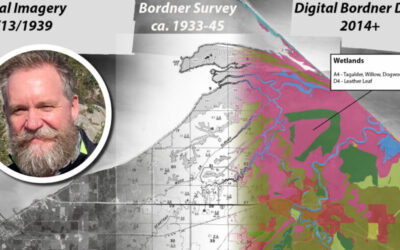
Wetland Coffee Break: Discovering historic Wisconsin geospatial data
A photo of speaker Howard Veregin over a map that shows one landscape with several different maps. Starting on the right with 1939 aerial imagery, then a survey map (the Bordner Survey) ca. 1933-1945, then into the colorful Digital Bordner Data from 2014 and onward with ‘wetlands’ pointed out.
Wetland Coffee Break: How you can help gather better information about rainfall and runoff through the “CoCoRaHS” program
Having accurate and local rainfall data impacts forecast accuracy and issue and timely and accurate flood watches and warnings. Local rainfall data also improves the modeling that communities use in their emergency management and restoration planning.
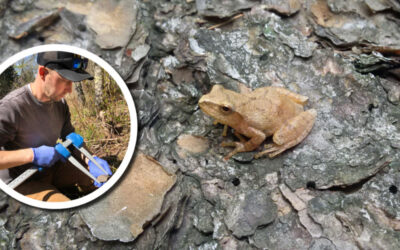
Wetland Coffee Break: The Wisconsin Frog & Toad Survey
Join DNR conservation biologist Andrew Badje to learn more about how you can become a “frogger” by lending your ears to monitor and help conserve frogs and toads in all corners of Wisconsin.
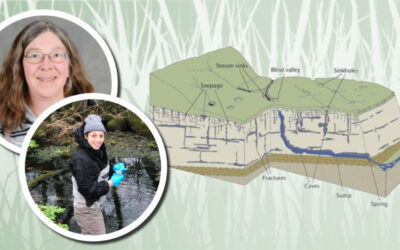
Wetland Coffee Break: Karst hydrogeology & wetlands
Have you ever heard of “karst”? Hydrogeologist Maureen Muldoon will provide an introduction to the hydrogeology of Wisconsin’s karst landscapes. Geologist Grace Graham will talk about the relationship between karst springs and wetlands.