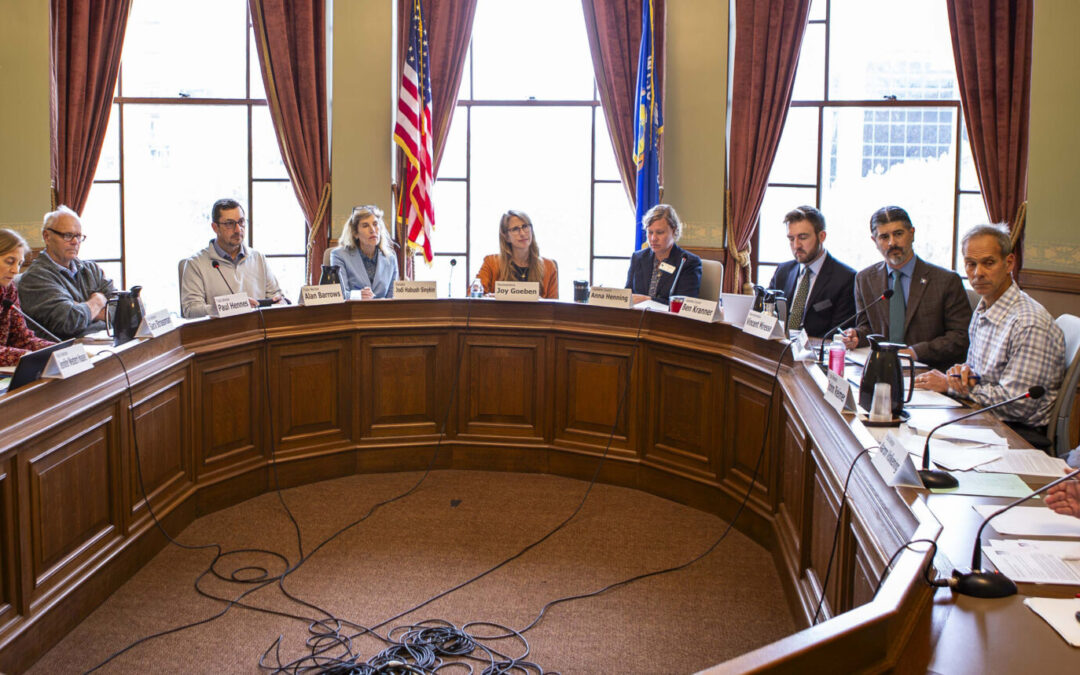
The Legislative Council Study Committee on Floodplain Restoration met on October 27, 2026, for its third discussion on state and federal regulatory barriers that hinder projects that restore and reconnect degraded floodplains. The discussion focused on key issues and potential policy solutions identified by Legislative Council attorneys and committee members.
The goal of the Study Committee is to come to agreement on legislation that could be introduced by the Joint Legislative Council in the 2027-28 Legislative Session. If introduced, that legislation would follow the normal legislative process, which requires public hearing and passage through committees and floor votes by the full Assembly and Senate. Following that, the bill would require the signature of the Governor to become law.
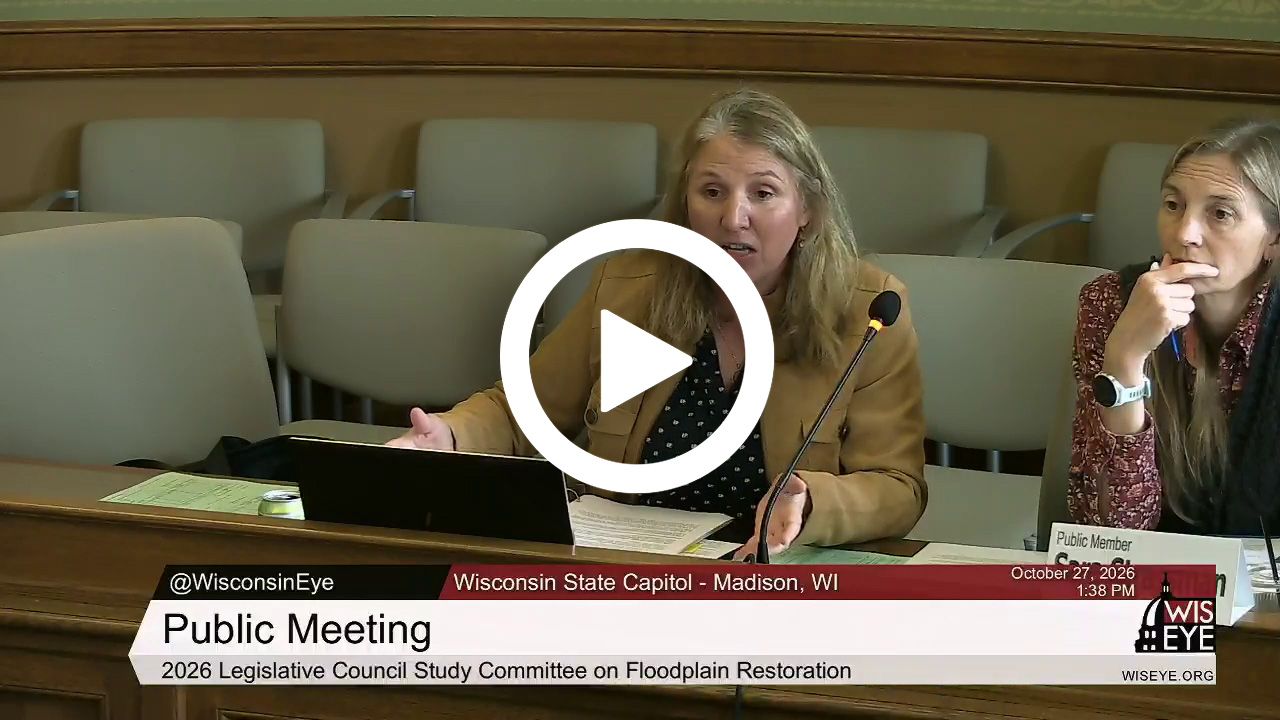
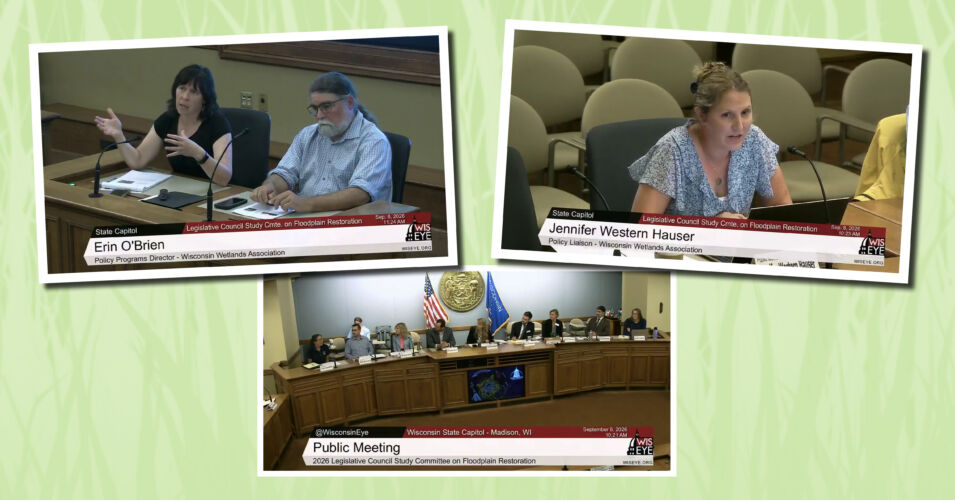
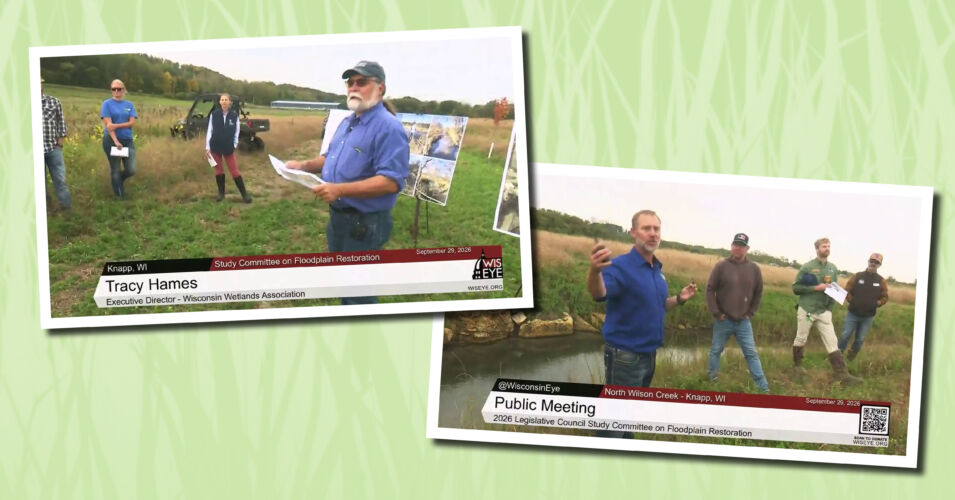
Click the image below to watch the meeting on WisconsinEye (a free account is required to view the recording).
Key ideas discussed at the October 27th meeting, which correspond to elements of the legislative draft, LRB 0516/P1 (posted here on the committee’s webpage) include:
Codifying the 1-foot maximum allowable rise within Zone A for floodplain restoration projects, where and to the extent allowed under federal law. Wisconsin Wetlands Association supports this clarification as it pertains to floodplain restoration and reconnection projects.
Defining floodplain restoration by considering a definition very similar to that which appears in the pending federal Floodplain Enhancement and Recovery Act. Many of the barriers the committee is working to address are rooted in policies pertaining to “development,” a term which does not distinguish between projects that encroach upon floodplain storage (such as by building structures) and projects that restore and reconnect floodplains to re-establish lost functions. By defining floodplain restoration, the committee is drawing this distinction and setting the stage for the type of activity the legislation would apply to.
Ensuring that state policy does not require Conditional Letter of Map Revisions (CLOMR) in cases where federal law does not require it. Currently, a CLOMR is required in certain situations, including if a project with a Zone A floodplain will cause a rise greater than 1-foot or if there is any rise in a Zone AE floodplain. However, if the Federal Floodplain Enhancement and Recovery Act passes, this provision would ensure that the model floodplain ordinance and local ordinances could not require a CLOMR in Zone AE floodplains if the project is exempt under new federal law.
Allowing a simplified procedure for an engineering study when certain conditions are met for “minor” floodplain restoration projects. This provision is meant to identify the situations in which an alternative to the detailed hydrologic and hydraulic engineering study could be considered for floodplain restoration projects. Specifically, the committee discussed the potential to allow a simplified study when all of the following applies:
- Owners of land on which the project will cause a rise in base flood elevation have granted permission for the project;
- The project will not affect insurable structures;
- The project is in an undeveloped area; and
- The community has a mechanism to track cumulative impacts.
This proposed remedy would allow the use of methods that are scaled to the level of risk posed by the project, and help prevent situations where the costs and complexity of the required study significantly increase and sometimes even far surpass the cost of the project itself.
Enabling the use of 2-Dimensional models to determine whether the project will result in a rise and better account for risks and benefits. In previous meetings, the committee heard from presenters who discussed the importance of looking across a project reach to understand the velocity and extent of flows, which is currently possible through the use of a 2-D model. This stands in contrast to the currently relied upon 1-dimensional model that scrutinizes cross sections across a project area to identify any amount of rise. The committee discussed that the goal of this provision is to allow floodplain restoration projects to be able to elect to use 2-D modeling, and for our DNR to begin to modernize the standards by which they can review these projects.
The committee will revisit these and other topics at its final meeting on December 8th. To catch up on the committee’s work, please visit the committee’s webpage where all the materials have been posted. You may also watch the committee meetings by creating a free account at WisconsinEye.
The Wisconsin Wetlands Association is fortunate to have a member on the Legislative Council Study Committee on Floodplain Restoration. If you have questions, please feel free to reach out to her at Jennifer.WesternHauser@wisconsinwetlands.org.
Related content
Proposed federal legislation would reduce barriers to restoring degraded floodplains
More about the proposed federal legislation referenced above.
Legislative Committee begins examining barriers to floodplain restoration
Learn more about the origins of the study committee and read a recap of the first meeting.
Study Committee on Floodplain Restoration second meeting recap