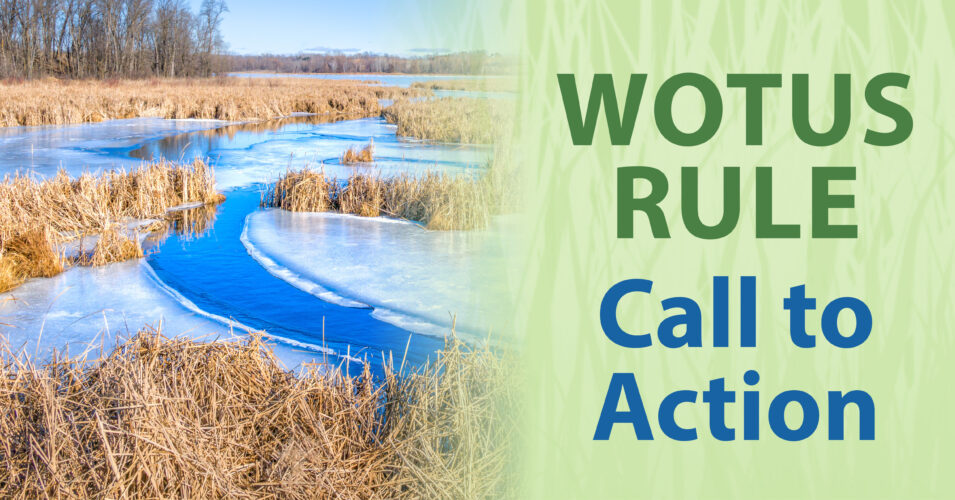
On November 20th, the Environmental Protection Agency and U.S. Army Corps of Engineers (EPA/COE) published a proposed rule in the federal register that both shrinks and sows confusion over what wetlands and waterways are subject to federal Clean Water Act (CWA) jurisdiction. The agencies are accepting public comment on the proposed changes through January 5th.
WWA policy staff are hard at work reviewing the proposed rule and coordinating our response with members, partners, and national NGOs. The proposed rule reinterprets the recent Supreme Court decision (Sackett vs EPA) in ways that reduce federal protections for wetlands and waterways in many ways. Key examples are that the Waters of the US (WOTUS) proposed rule:
- Limits federal jurisdiction to relatively permanent waters. Relatively permanent is defined as “standing or continuously flowing bodies of surface water that are standing or continuously flowing year-round or at least during the wet season.” The proposed rule does not yet include a definition for the term “wet season.”
- Severs jurisdiction for tributaries that contribute surface water flow through non-jurisdictional features such as culverts, dams, or tunnels, or through wetlands, boulder piles or similar natural features, if such feature does not convey relatively permanent flow. Culverts do not sever jurisdiction if it extends the relatively permanent water, but the culvert must have an ordinary high-water mark. Further, a tributary that loses flow through an ephemeral stretch—i.e., waters with surface flow only in direct response to precipitation—would no longer confer jurisdiction upstream.
- Limits protections for wetlands to those that have a continuous surface connection, which is defined as having continuous surface water at least during the wet season and abutting (i.e., touching) a jurisdictional water. Saturation or a high-water table are not enough to meet this requirement, and only portions of a wetland with continuous surface hydrology uninterrupted throughout the wet season are jurisdictional, regardless of the wetland scope or size. This means that mosaic wetlands are no longer “one wetland” but individual wetlands that must meet both new criteria.
- Includes other provisions that expand exclusions for ditches and significantly increase allowances for unregulated conversion of drained agricultural lands (wetlands) to non-agricultural uses.
If enacted as proposed, these provisions combined would leave an estimated 80% of all wetlands in the nation and 5 million miles of streams without protection under the federal Clean Water Act.
While the national implications of the proposed rule are dire, fortunately potential Wisconsin impacts will be limited to situations where non-federal wetlands (as defined in the final rule) are also eligible for an exemption in state statutes. Even so, the proposal warrants a firm response from Wisconsin.
Key points we will make among others include:
- The rule is unnecessary because there is already a rule that conforms with the most recent Supreme Court decision (Sackett vs EPA);
- The rule is excessive in that it reduces wetlands and waterways protections far beyond what the Supreme Court required under the Sackett decision;
- The rule is unworkable because decisions on whether a federal permit is needed will have to be made on a case-by-case basis and will require use of data that is not reliably available for most wetlands and streams.
Please consider adding your voice to ours and other water advocates across the nation in opposition of the new WOTUS rule. You can help by submitting comments on how the rule will affect the nation’s wetlands and waterways, and how degraded wetlands and waterways affect Wisconsin’s waters, public safety and health.
When drafting your comments, please consider the following recommendations:
- Make it personal – Share your relevant demographics, geographic context, expected impacts, etc.
- Make it specific – Describe why clean water matters to you, your community, or your work. For example:
- Concerned citizen may want to include details such as the connections between wetlands, streams and your source of drinking water, or examples of how wetland loss and stream degradation have contributed to flooding, water quality, and recreational opportunities in your community.
- Wetland professionals may want to address the suggestions above, but could also provide insights on expected implementation difficulties and how the proposed rule will affect the time and expense of making jurisdictional determinations.
- Include an ask – Choose from one or both of the following options, or craft your own:
- Ask the agencies to reconsider its update to the definition of the “Waters of the United States” rule and stick with the 2023 (Sackett conforming) rule that’s already in place.
- Ask the agencies to maintain protections for the nation’s wetlands and waterways to the maximum extent allowed under the Sackett decision.
Your engagement will help us deliver a strong and well-supported message that Wisconsin values clean and healthy waters, and will help demonstrate that no matter what’s proposed, Wisconsin citizens will continue to advocate for the protection and restoration of wetlands to solve problems.
Comments are due no later than January 5th. To submit comments, click here.
Please also help us track Wisconsin’s response by sending a copy of your comment letters to info@wisconsinwetlands.org.