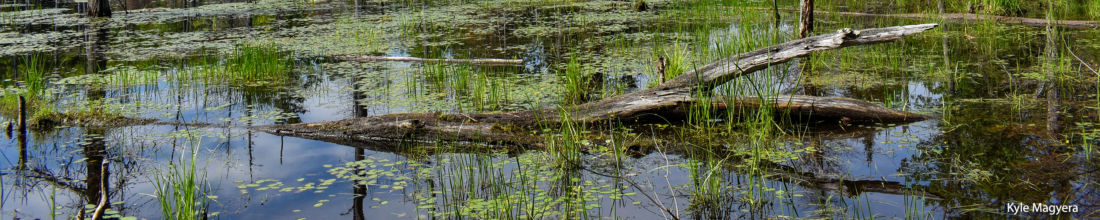
Due to its unique geography, geology and climate, Wisconsin has been blessed with a large diversity and abundance of wetland ecosystems. At the time of early European settlement, more than 10 million acres of wetland were found in what now constitutes Wisconsin. During the past 150, we have lost almost 50%, or five million acres, of our original wetland heritage, and a large portion of the wetlands that remain (especially in the populated southern half of the state) are considerably degraded.

Remaining wetlands represent significant economic value for our state because of the ecological services they provide including flood prevention and water purification. Wisconsin's wetlands also contribute to our tourism economy; examples of Wisconsin's twelve wetland communities can still be visited and enjoyed. These Wetland Communities of Wisconsin webpages briefly describe the state's diverse wetland communities and some of their most characteristic features, including the flora found there.

The following table, adapted from Wisconsin Department of Natural Resources’ Land Legacy Report1 and Wildlife Action Plan2 illustrates which wetland communities are found in which regions of the state:


For more information about each of these plant community types, click on the links at the top of this page. The wetland plant community descriptions and diagrams on these pages are excerpted from Eggers, S.D. and D.M. Reed. 1997. Wetland Plants and Plant Communities of Minnesota and Wisconsin. (2nd Edition). U.S. Army Corps of Engineers, St. Paul, MN.


  1. Pohlman, John D., Gerald A. Bartelt, Andrew C. Hanson III, Paul H. Scott, and Craig D. Thompson (Editors). 2006. Wisconsin Land Legacy Report: An inventory of places to meet Wisconsin’s future conservation and recreation needs. Wisconsin Department of Natural Resources, Madison, WI.
  2. Wisconsin Department of Natural Resources. 2005. Wisconsin's Strategy for Wildlife Species of Greatest Conservation Need. Madison, WI.

>> Back to top of this page