Bogs and fens
Bogs and fens are uncommon wetland communities with water chemistry (pH) at the extremes: bogs are acidic, and fens are (mostly) basic or alkaline. Because of their water and soil conditions, bogs and fens are home to rare and specialized plants. Bogs receive their water from rainfall and snowmelt. Their saturated, acidic soils are low in nutrients. Fens, however, receive mineral inputs from groundwater in addition to precipitation; sometimes this groundwater can be alkaline and calcium-rich, but other times fens are acidic (these are called “poor fens”).
How to recognize them
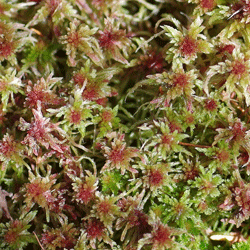
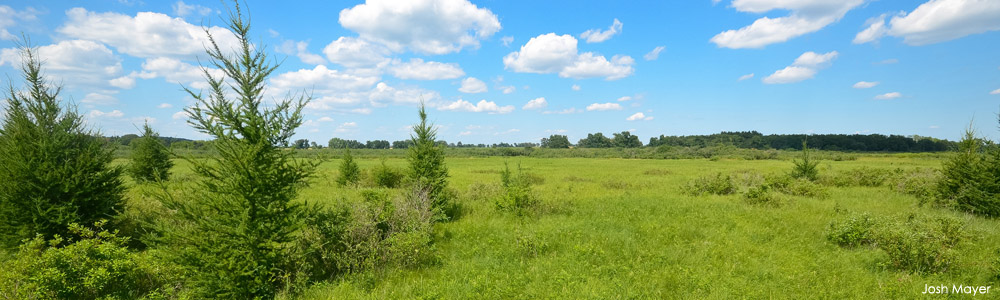
Bogs are identified by a dense, continuous mat of sphagnum moss and often have stunted coniferous trees. Often, bogs will have a spongy mat of vegetation that floats on the water underneath it. You can feel this mat bounce when you walk on it. In some fens, white mineral deposits can appear where the springs arise from calcium-rich bedrock. In other fens, the flow of groundwater promotes plant growth that creates a mound over time, creating the unusual situation where the wetland is higher than the drier area surrounding it.
Plants and animals to look for