|
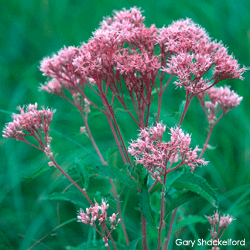
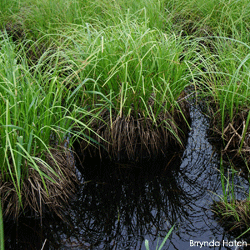
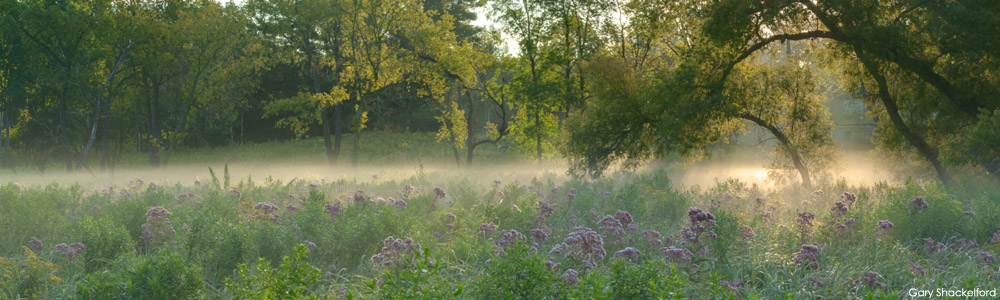
Meadows are essentially closed wetland communities (nearly 100 % vegetative cover) composed of perennial forb, grass, and sedge mixtures growing on saturated soils. Woody plants are not dominant, and standing water is usually only present during floods and snowmelt. Meadows often form a transition zone between aquatic communities and uplands. Peat/muck soils are frequently present, indicating permanent saturation and anaerobic conditions. Plants occurring in meadows include species found in other communities, such as the annuals of seasonally flooded basins, emergent aquatic plants of marshes, and invading shrubs or trees, which are present as scattered, small individuals. The forbs, grasses, and sedges of meadows can tolerate inundation to a greater degree than most woody species, but they suffer if inundation during the growing season lasts for more than one or two weeks. Because these wetlands lack standing water during most of the growing season, they are often called "dry marshes."
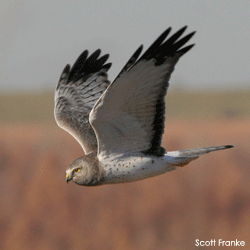
Meadows are particularly important for their water quality protection functions. These involve the trapping of sediments and assimilation of nutrients. Meadows are also important for stormwater and floodwater retention. Wildlife habitat is provided for many species including sandhill crane, ring-necked pheasant, common snipe, sedge wren, small mammals, and white-tailed deer. The abundance of small mammals supports mink, fox, and raptors such as the northern harrier. The composites (e.g. sunflowers and asters) found in these meadows are an important fall and winter food source for songbirds. Meadows are often used for pasture or cut for "marsh hay".
Meadows include two of the rarest wetland plant communities - fen and low prairie - that support a disproportionate number of rare, threatened, and endangered species.
Prairies are open, herbaceous plant communities dominated by native grass and grass-like species; at least half of the vegetative cover is made up of true grasses. These communities are dominated by native grasses and forbs associated with prairies such as prairie cord-grass, big bluestem, gayfeather, New England aster, culver’s root, prairie dock, and sawtooth sunflower. Low prairie communities only occur south of the vegetation tension zone, although a few prairie species may be found in sandy barrens and wet swales north of the tension zone.
Prairie communities occur along a moisture gradient from wet (low prairies) to dry (dry prairies). The wet end of the gradient, low prairies, meet the criteria for wetlands.
Prior to European settlement, vast expanses of prairie existed in southern Wisconsin. Prairies evolved with fire and fire is essential to maintenance of prairies. Without periodic burns, prairies become subject to invasion by woody vegetation. In the pre-European settlement landscape, huge wildfires roared across the prairies of Wisconsin. European settlement brought two things to the prairie: the plow and fire suppression. Once the prairie sod was broken, and the wet prairies were drained, the deep, black soils proved to be among the most productive farmland in the world. More than 99 percent of prairies in Wisconsin were destroyed by the conversion to agricultural use. Prairies that were not plowed under were hayed or intensively grazed for decades resulting in degradation and changes in species composition. Remaining remnant prairies often suffer because of fire suppression and may be lost without intensive management. Given this nearly total loss of prairie, it is not surprising that prairie species once common in Wisconsin are now threatened or endangered. Two prairie orchids, the western prairie fringed orchid and the white lady-slipper, are prime examples.
Some large tracts of virgin (never plowed) or otherwise high quality prairie still exist on publicly-owned preserves or those purchased and managed by private conservation groups. A notable example is the Chiwaukee Prairie in Kenosha County.
The Wisconsin Natural Heritage Inventory divides this community type into two separate community types: wet prairie, and moist sandy meadow. Click here to read the Wisconsin Department of Natural Resources’ community descriptions for these community types.
The wetland plant community description in italics above is excerpted from Eggers, S.D. and D.M. Reed. 1997. Wetland Plants and Plant Communities of Minnesota and Wisconsin. (2nd Edition). U.S. Army Corps of Engineers, St. Paul, MN.
|