|
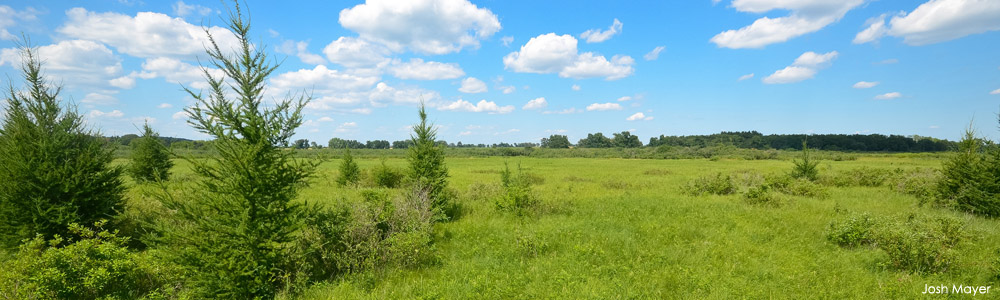
Fens are one type of meadow. Meadows are essentially closed wetland communities (nearly 100 % vegetative cover) composed of perennial forb, grass, and sedge mixtures growing on saturated soils. Woody plants are not dominant, and standing water is usually only present during floods and snowmelt. Meadows often form a transition zone between aquatic communities and uplands. Peat/muck soils are frequently present, indicating permanent saturation and anaerobic conditions. Plants occurring in meadows include species found in other communities, such as the annuals of seasonally flooded basins, emergent aquatic plants of marshes, and invading shrubs or trees, which are present as scattered, small individuals. The forbs, grasses, and sedges of meadows can tolerate inundation to a greater degree than most woody species, but they suffer if inundation during the growing season lasts for more than one or two weeks. Because these wetlands lack standing water during most of the growing season, they are often called "dry marshes".
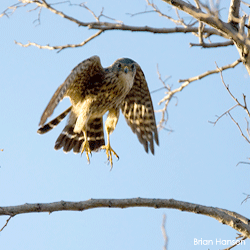
Meadows are particularly important for their water quality protection functions. These involve the trapping of sediments and assimilation of nutrients. Meadows are also important for stormwater and floodwater retention. Wildlife habitat is provided for many species including sandhill crane, ring-necked pheasant, common snipe, sedge wren, small mammals, and white-tailed deer. The abundance of small mammals supports mink, fox, and raptors such as the northern harrier. The composites (e.g. sunflowers and asters) found in these meadows are an important fall and winter food source for songbirds. Meadows are often used for pasture or cut for "marsh hay".
Meadows include two of the rarest wetland plant communities - fen and low prairie - that support a disproportionate number of rare, threatened, and endangered species.
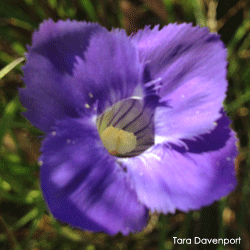
Fens are the rarest wetland plant community in Wisconsin, and probably one of the rarest in North America. These are plant communities of wet seepage sites that have an internal flow of groundwater rich in calcium and magnesium bicarbonates, and sometimes calcium and magnesium sulfates as well. The calcium and magnesium bicarbonates and sulfates precipitate out at the surface, creating a harsh, alkaline soil condition. Only a select group of calcium-tolerant plants, referred to as calciphiles, can tolerate these conditions. Characteristic species include shrubby cinquefoil, sterile sedge, wild timothy, beaked spike-rush, Ohio goldenrod, common valerian, and lesser fringed gentian. Also included are species disjunct from the tundra, alpine meadows, and salt marshes. Therefore, fens have been referred to as a hybrid community.
Fen communities in general have a disproportionate number of rare, threatened, and endangered plant species compared to other plant communities in the Great Lakes Region.
Trout streams are often associated with calcareous fens because of the cold, pure water provided by the springs and seepages. Active springs are frequently associated with calcareous fens.
The Wisconsin Natural Heritage Inventory divides this community type into four separate community types: bog relict, calcareous fen, boreal rich fen, and shore fen. Click here to read the Wisconsin Department of Natural Resources’ community descriptions for these community types.
The wetland plant community description in italics above is excerpted from Eggers, S.D. and D.M. Reed. 1997. Wetland Plants and Plant Communities of Minnesota and Wisconsin. (2nd Edition). U.S. Army Corps of Engineers, St. Paul, MN.
|