|
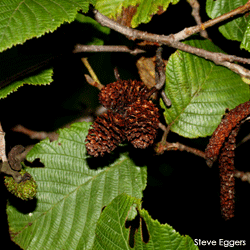
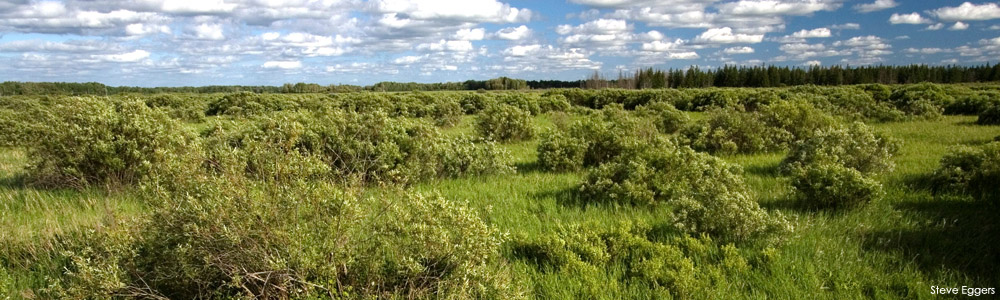
Shrub swamps are wetland plant communities dominated by woody vegetation less than 20 feet in height and with trunks of less than 6 inches in diameter at 1 meter height. Shrub swamps of Wisconsin are categorized as shrub-carrs and alder thickets depending on the dominant shrub species. Both occur on organic soils (peat/muck) as well as on the alluvial mineral soils of floodplains.
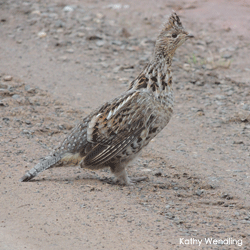
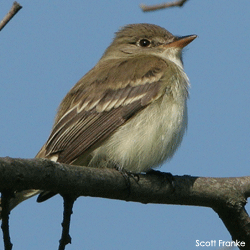
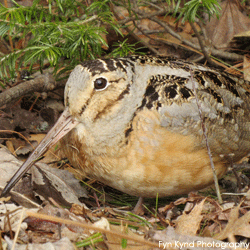
Shrub swamps provide high value habitat for many songbirds, ruffed grouse, American woodcock, and small mammals, and may be particularly important winter habitat for eastern cottontail and white-tailed deer.
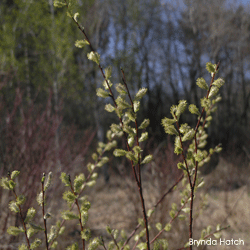
Shrub carrs are plant communities composed of tall, deciduous shrubs growing on saturated to seasonally flooded soils. They are usually dominated by willows and/or red-osier dogwood, and sometimes silky dogwood. The groundlayer typically includes some of the ferns, sedges, grasses, and forbs of sedge meadow communities. The diversity of species composing the groundlayer is dependent on degree of shrub canopy cover, degree of disturbance, and water source. For example, disturbed shrub-carrs may have a groundlayer dominated by a single species - reed canary grass. Relatively undisturbed shrub-carrs may have a groundlayer that includes a rich diversity of species.
Shrub-carrs are common both north and south of the vegetation tension zone. Artificial drainage and suppression of fire are two factors that promote expansion of shrub-carr communities into meadows.
The Wisconsin Natural Heritage Inventory recognizes shrub carr as a natural community type. Click here to read the Wisconsin Department of Natural Resources’ community descriptions for these community types.
The wetland plant community description in italics above is excerpted from Eggers, S.D. and D.M. Reed. 1997. Wetland Plants and Plant Communities of Minnesota and Wisconsin. (2nd Edition). U.S. Army Corps of Engineers, St. Paul, MN.
|