|
Natural communities are wonderfully variable and complex. What types of soils, plants, and animals are present in a given place are determined by local conditions including geology, altitude, hydrology, and climate. Small changes to one or more of these conditions could result in an entirely different suite of soils, plants or animals living at that place. This complexity is one of the things that makes nature, and wetlands specifically, so interesting. But this also makes it difficult to classify natural communities into distinct categories when on the ground variations among natural communities exists on a gradual continuum.
What are the factors that we could use to group some wetlands together and separate others? We could classify wetlands based on quantity of water; seasonality of water; source of water (groundwater, surface water); predominant vegetation (grasses, sedges, trees, shrubs, reeds); water chemistry; predominant animal life; or any number of other factors. For a variety of reasons, the most common factor used to classify natural communities is plant life.
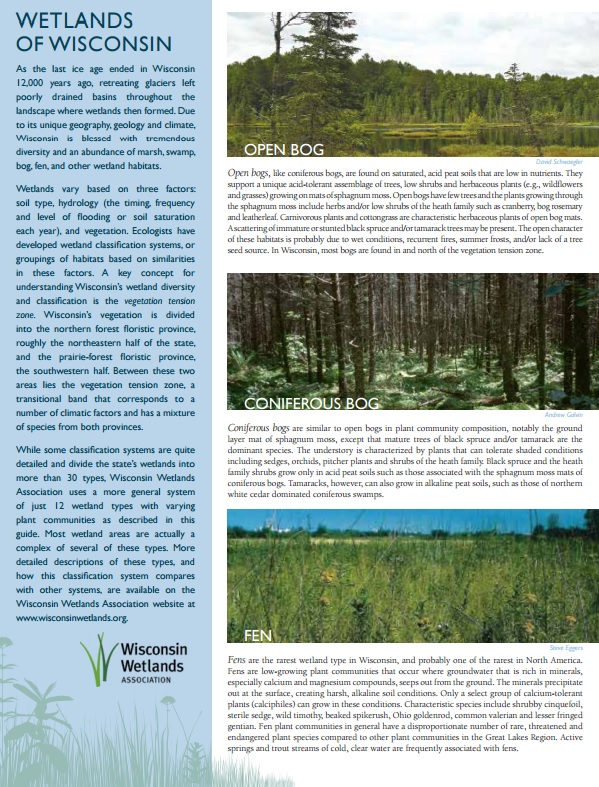
The wetland classification system Wisconsin Wetlands Association uses identifies twelve different wetland plant community types as listed below. WWA has produced a brochure with short descriptions and photos of each of these types; click the image to the right to download a copy. There are several different systems that classify wetlands by plant communities including Eggers and Reed1, Wisconsin Natural Heritage Inventory2, and The Nature Conservancy3. To see how Wisconsin Wetlands Association's system described below compares with these classification systems, have a look at our "Community Crosswalk".
Several additional types are rare or localized, including interdunal wetland and fresh wet meadow, and are not described here.
Because of local differences (including geology, altitude, hydrology, and climate), not all of these wetland types are common (or even present) in all parts of the state. In the north, for example, bogs are more common, and in the south, wet prairies are more common. Diagonally across the middle of the state (roughly corresponding to the route of Interstate 94) is a "tension zone" that roughly draws the border between northern and southern Wisconsin with respect to plant communities.
|